Data
What we already retain
What happened?
- Financials
- Occupancy
- Collections
- Traffic
- Work orders
- Leasing activity
What I’m exploring
Multifamily has become very good at capturing what happened. I’m interested in the layer that is still easy to lose: what a property has learned, why decisions were made, and what experienced operators know — and how that knowledge can shape what happens next.
A frame I’m using
Multifamily has become very good at capturing and retaining data. What is still missing is a reliable way to preserve the knowledge around it. Without that layer, the intelligence we can build on top remains limited.
Data
What we already retain
What happened?
Knowledge
The missing layer
What do we know — and why?
Intelligence
What becomes possible
What can we do with what we know?
Better intelligence does not come from more data alone. It depends on preserving the knowledge that gives that data context.
Where the knowledge gets lost
We retain data far better than we retain the knowledge around it. Three kinds of operating knowledge are especially easy to lose: what the property has learned, why decisions were made, and what experienced operators know.
Property memoryNot captured
What has this property learned?
A property accumulates history: recurring issues, prior attempts, lessons learned, and how conditions changed over time. Much of that history still lives across people and systems, so when teams change, too much has to be rebuilt.


Decision contextNot preserved
Why was this decision made?
The outcome may be visible, but the reasoning often is not. Approvals, tradeoffs, assumptions, and what was tried before disappear, leaving the next team with the number but not the context behind it.


Operating know-howNot compounded
What does an experienced operator know?
Experienced operators build judgment over years — what to notice, what to question, and what tends to work. When that know-how stays with individuals or local teams, the organization struggles to build on it across properties.


The role AI can play
The knowledge already exists in everyday work — in meetings, site visits, property walks, emails, approvals, photos, reports, and the judgment experienced operators apply every day.
AI can help capture, structure, and connect that knowledge — then bring the relevant context back when a team needs it.
Organize property history, major events, decisions, incidents, action items, contracts, and operating history so the property’s knowledge remains usable over time.

Preserve what was decided, why it was decided, what alternatives were considered, what constraints shaped the choice, who approved it, and what happened next.

Capture patterns, proven practices, signals, and lessons from experienced operators — then make that knowledge reusable across teams and properties.

From knowledge to intelligence
Preserved knowledge becomes intelligence when the relevant property memory, decision context, and operating know-how are available at the moment a team needs to act.
Property Memory + Decision Context + Operating Know-How → Better Next Decision
Going deeper
Property memory is one part of the larger knowledge problem. I’m taking that thread deeper in a book about what organizations lose when operating context disappears — and what AI may make possible.
About the book →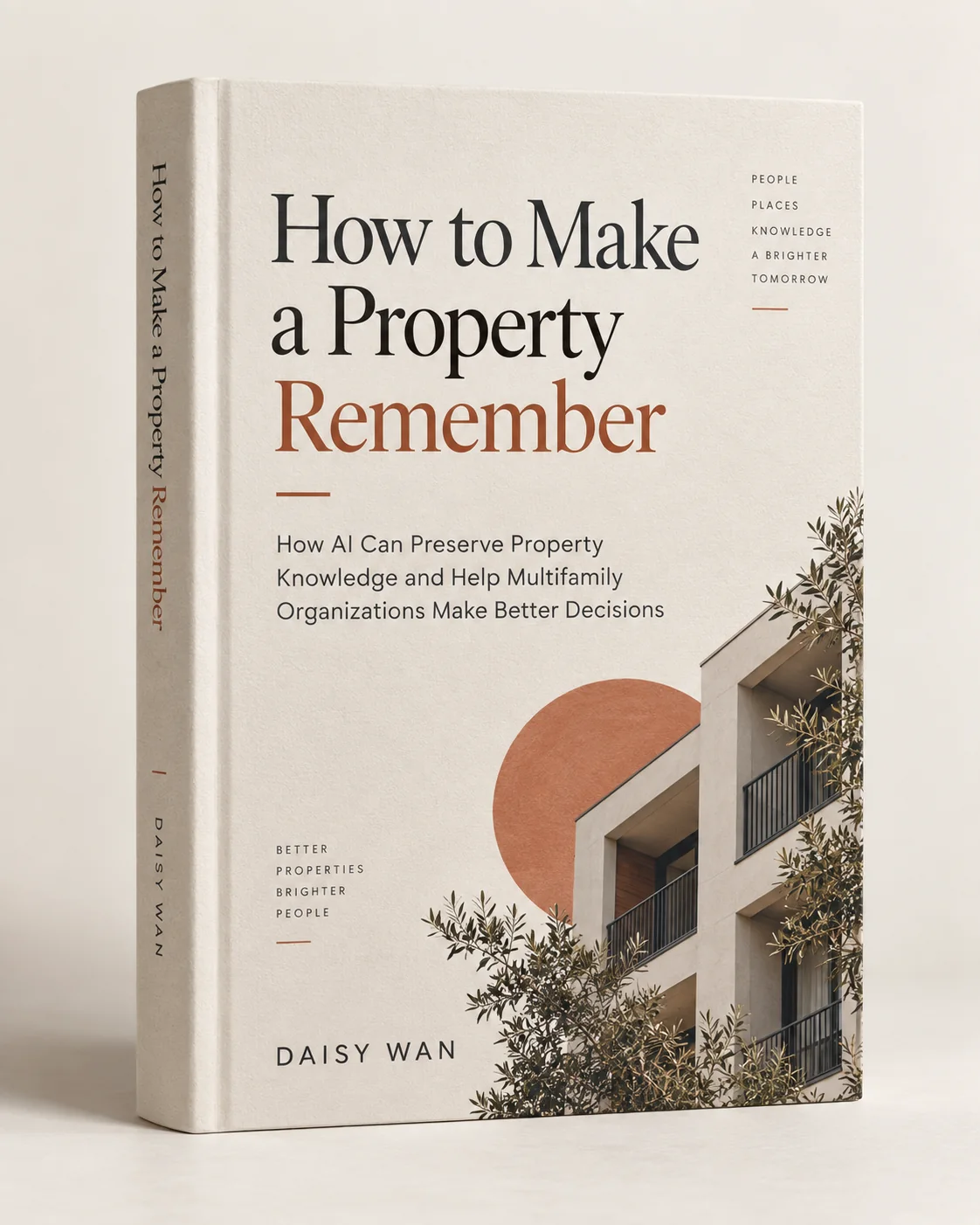
Newsletter
Exploring how AI can help multifamily organizations work, learn, and make better decisions.